





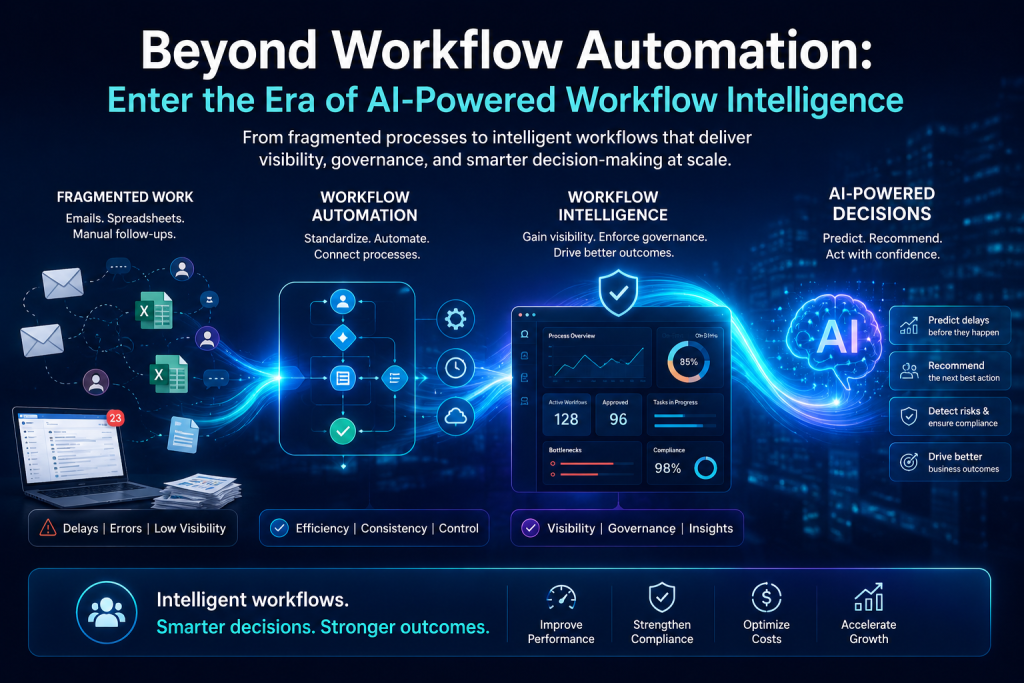
Beyond Workflow Automation: Enter the Era of AI-Powered Workflow Intelligence
How modern enterprises are transforming fragmented processes into intelligent workflows that deliver visibility, governance, and smarter decision-making at scale.
Introduction
Over the years, Qruize have helped organizations modernize workflows across procurement, budgeting, scientific activities, customer operations, and enterprise approvals.
Different industries.
Different business challenges.
Different technology environments.
Yet every transformation revealed the same problem.
Work wasn’t breaking because technology failed.
Work was breaking because workflows did.
A procurement request sat waiting in someone’s inbox.
A budget approval required multiple follow-ups.
A customer-facing process relied on spreadsheets to track progress.
Critical business information was scattered across emails, spreadsheets, and disconnected systems.
The surprising part?
Most of these organizations have already invested in enterprise applications, ERP platforms, reporting tools, and collaboration technologies.
Technology wasn’t the missing piece.
Visibility was.
Consistency was.
Governance was.
And most importantly, the way work moved across the organization was.
As organizations grow, processes naturally become more complex. New stakeholders enter approval chains. Regulatory requirements increase. Data begins to flow across multiple systems. What once worked for a small team gradually becomes difficult to manage at scale.
Over time, these inefficiencies create what we often refer to as process friction—the hidden operational drag that slows decisions, impacts governance, and limits business agility.
As we looked across these transformation journeys, we realized they all pointed toward a larger shift.
A shift beyond workflow automation.
A shift toward what we now describe as Workflow Intelligence.
At Qruize, we describe Workflow Intelligence as the convergence of automation, visibility, governance, and AI-driven decision support—helping organizations operate smarter, faster, and with greater confidence at scale.
We’ll explore this concept throughout the article, but at its core, Workflow Intelligence is about helping organizations create visibility, governance, and smarter decision-making across their operations.
For enterprises looking to remain agile in an increasingly digital world, this shift is becoming a strategic necessity rather than a technology initiative.
When Good Processes Stop Scaling
None of the organizations we worked with deliberately designed inefficient processes.
In fact, most workflows started as good processes.
A spreadsheet solved a reporting problem.
An email approval added accountability.
A shared tracker improved collaboration.
A manual review step reduced risk.
Each decision made perfect sense at the time.
The problem wasn’t how these processes started.
The problem was how they scaled.
What worked for ten people often struggled to support hundreds.
What worked within one department became difficult to manage across multiple functions.
As organizations expanded, approvals multiplied, systems increased, data became fragmented, and visibility began to decline.
Without realizing it, many enterprises found themselves relying on a growing network of emails, spreadsheets, meetings, and manual handoffs to keep operations moving.
This is where process friction begins to appear.
A request remains pending because an approver is unavailable.
A budget update requires multiple follow-ups before accurate information becomes available.
A customer-facing activity is delayed because teams lack visibility into the next step.
An operational decision is postponed because critical information must first be gathered from multiple systems.
Individually, these delays may seem minor.
Collectively, they create a significant impact on productivity, responsiveness, and business performance.
Most operational problems are workflow problems in disguise.
"Enterprises don't suffer from a technology gap.
They suffer from a workflow gap."
What appears to be a reporting issue is often a visibility issue.
What appears to be an approval issue is often a workflow issue.
What appears to be a productivity issue is often the result of fragmented processes that no longer support the scale and complexity of the business.
The issue is rarely a lack of effort from employees. Teams often work harder to compensate for inefficient processes, spending valuable time tracking updates, coordinating activities, and resolving exceptions.
However, as operational complexity increases, human effort alone cannot solve structural workflow challenges.
Organizations eventually reach a point where adding more people, more meetings, or more oversight no longer improves efficiency.
Instead, it increases complexity.
This is why many enterprises today are rethinking not just how work is performed, but how workflows are designed, managed, and optimized.
The focus is shifting from managing individual tasks to managing end-to-end workflows that connect people, systems, data, and decisions.
And that shift is laying the foundation for something much larger than workflow automation.
It is creating the conditions for Workflow Intelligence—where workflows not only move work efficiently but also provide the visibility, governance, and operational context needed for smarter decision-making.
The Reality of Modern Enterprise Operations
Consider a typical enterprise workflow.
A request is initiated by one team.
It requires approvals from multiple stakeholders.
Data must be validated across different systems.
Progress needs to be tracked.
Reports must be generated.
Decisions need to be made.
On paper, each step appears straightforward.
In reality, work often moves through a combination of emails, spreadsheets, meetings, and manual follow-ups.
As organizations grow, these workflows become increasingly difficult to manage.
Approvals are delayed because stakeholders lack visibility.
Operational data becomes fragmented across systems.
Teams spend valuable time coordinating activities rather than driving outcomes.
Leaders struggle to answer fundamental questions:
Where is work getting delayed?
Which approvals are creating bottlenecks?
What operational risks require attention?
How can decisions be made faster and with greater confidence?
These challenges appear across industries and business functions.
Whether managing budgets, customer operations, procurement activities, field operations, or enterprise approvals, the underlying issue remains remarkably similar.
Workflows have become fragmented.
And fragmented workflows create fragmented decision-making.
This is why organizations are increasingly moving beyond simple workflow automation.
The objective is no longer just to digitize work.
The objective is to create workflows that provide visibility, governance, context, and intelligence.
That shift is laying the foundation for the next evolution of enterprise operations.
From Workflow Automation to Workflow Intelligence
Once workflows become connected, visible, and governed, what comes next?
For years, enterprises focused on digitizing work and automating processes.
Requests were routed automatically.
Approvals followed predefined paths.
Data moved seamlessly between systems.
These capabilities remain essential.
But organizations are increasingly looking beyond efficiency alone.
They want workflows that can provide insights, anticipate issues, identify bottlenecks, and support better decision-making in real time.
This is where Workflow Intelligence begins to take shape.
Workflows are no longer evolving simply as process engines.
They are evolving into decision-support systems.
And Artificial Intelligence is accelerating that transformation.
The Emerging Role of AI in Enterprise Workflows
Artificial Intelligence is accelerating this evolution.
Rather than replacing human decision-making, AI is enhancing it by helping organizations process information faster and uncover insights that may otherwise remain hidden.
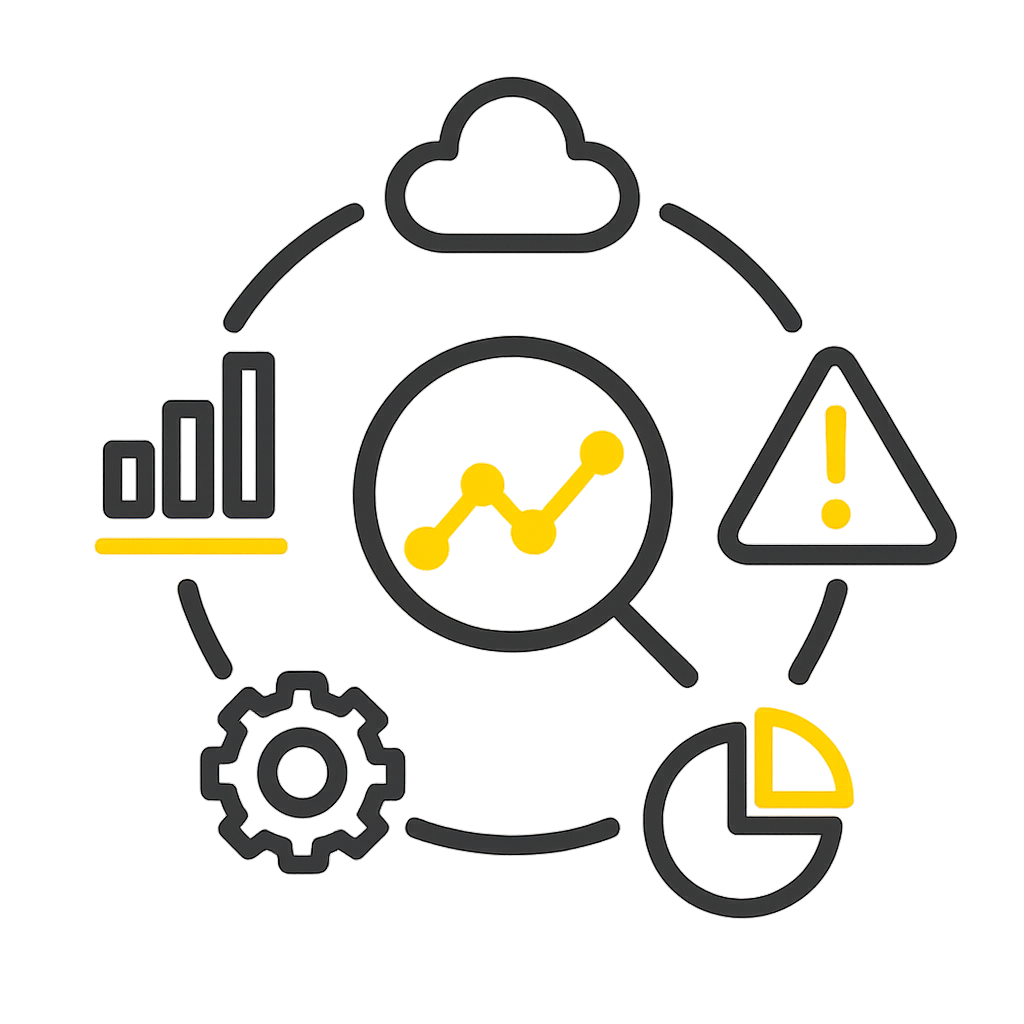
Across enterprise workflows, AI is beginning to support:
Intelligent Routing
Instead of relying solely on predefined business rules, workflows can dynamically recommend the most suitable path based on workload, historical decisions, and operational context.
Document Intelligence
AI-powered systems can extract, classify, and validate information from documents, emails, forms, and attachments, reducing manual effort while improving accuracy.
Predictive Insights
Organizations can identify workflow bottlenecks, approval delays, and operational risks before they impact business outcomes.
Decision Support
AI can analyze historical process data and recommend actions, helping stakeholders make faster and more informed decisions.
Process Optimization
By continuously analyzing workflow performance, AI can identify inefficiencies and opportunities for improvement across business operations.
Building the Foundation for Workflow Intelligence
One of the biggest misconceptions about AI is that its purpose is to replace human decision-making.
The most effective enterprise workflows continue to rely on human expertise, judgment, and accountability.
What changes is the quality of information available to decision-makers.
Instead of spending time gathering updates, tracking approvals, and coordinating activities, teams can focus on evaluating options, solving problems, and driving outcomes.
AI becomes an operational partner rather than a replacement.
The goal is not autonomous decision-making.
The goal is intelligent decision-making.
The End of Email-Driven Operations
For decades, enterprises have focused on improving operational efficiency through digitization and automation.
Today, the conversation is shifting.
The next phase of enterprise transformation is no longer about simply accelerating work. It is about enabling smarter decisions, greater visibility, and more intelligent operations.
The organizations leading this shift recognize that operational excellence is not determined by the number of systems they deploy. It is determined by how effectively people, processes, data, and decisions work together.
Ready to move beyond workflow automation?
to explore how intelligent workflows can transform your operations.